
Dancing with Tags
Virtual Intelligence, P.I.
I would like to take you back over a decade. The year is 2012. You’re playing this brand-new card game called Android Netrunner. You’ve heard this card Account Siphon is pretty good, so you slam it down onto the table with a smile. Your opponent subtracts five from their credit total, and you gain a whopping ten.
“Oh, don’t forget, you also get two tags.” Your opponent says.

Right. Tags. You haven’t played much corp yet, so you don’t quite know what they do, though you’ve heard they’re bad. You look at the basic action card and see that you can pay a click and two credits to remove a tag. On the other side, you see that the corp can spend a click and two credits to trash one of your resources as long as you’re tagged.
Better get rid of them then, you have some good resources you want to play with the money you just stole. You spend one click to remove a tag, ending your turn with one tag that you’ll get around to clearing next turn. How bad could being tagged really be?
Something old, something new
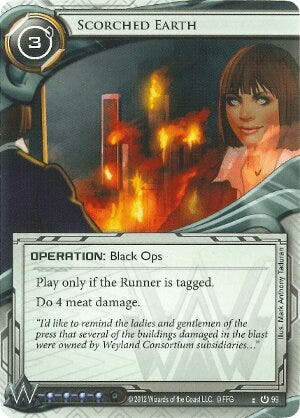
These days, tags are a lot less brutal. Even before NSG took over stewardship of the game, the value of a tag was already changing. A single tag could easily be a kill while Scorched Earth was around, but by the end of the FFG era it was replaced with High-Profile Target or BOOM!, putting the threshold for a flatline at two tags.

However, tag punishment was not the only thing that had changed in the interim years. The ability for the runner to give themselves tags, as well as the rewards for doing so, had also been greatly expanded. This resulted in so-called “tagme” decks, that piled up tags for rewards that scaled with the amount of tags they got. Perhaps most famously, Mars for Martians had to be banned because of its uncapped nature. Even now, it is on the Eternal points list.


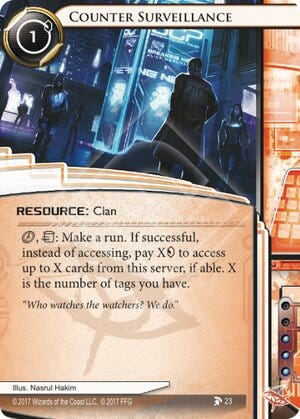
Between Obelus for additional hand size and Jarogniew Mercs for meat damage protection, getting flatlined was often only of minor concern. Meanwhile, cards like Counter Surveillance and Hot Pursuit provided powerful rewards for those willing to take the tags.

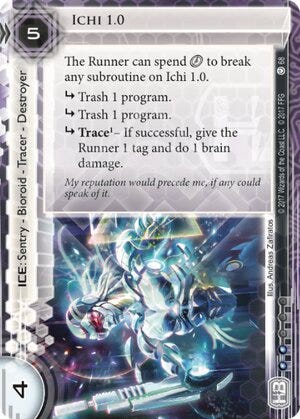
However, what perhaps most defines this era of tagme decks is the difference in power it could have between matchups. At this time, there were no tag punishment cards in HB or Jinteki. There had been one or two cards that gave tags (Ichi 1.0 going back to the original core set), but if you wanted tag punishment, you had to import that. And if your faction was bad at giving tags, why would you import tag punishment?
Because one of the fundamental problems with tags is that the only punishment available by default, the basic action, targets a certain card type. And so, these decks simply did not play any resources that needed to stick around. Sure, if the corp wants to spend two credits and a click to trash The Class Act, the runner already got their four cards.
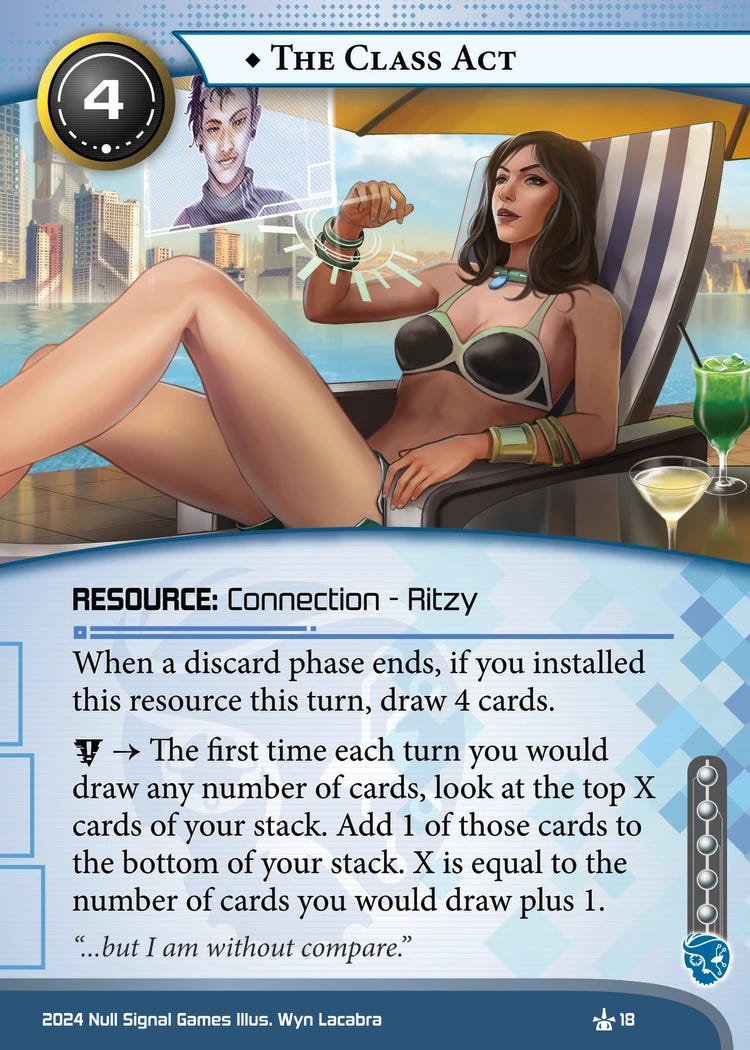
And so, when playing against HB or Jinteki, what was supposed to be a drawback to balance these powerful cards became nothing more than a deckbuilding concern. Tags only mattered against one, maybe two corps.
Past, Present…
The biggest changes for what tags meant came with the Liberation cycle. The Automaton Initiative features at least one card for each corp faction that cares about tags. And the two for HB and Jinteki deserve special mention.
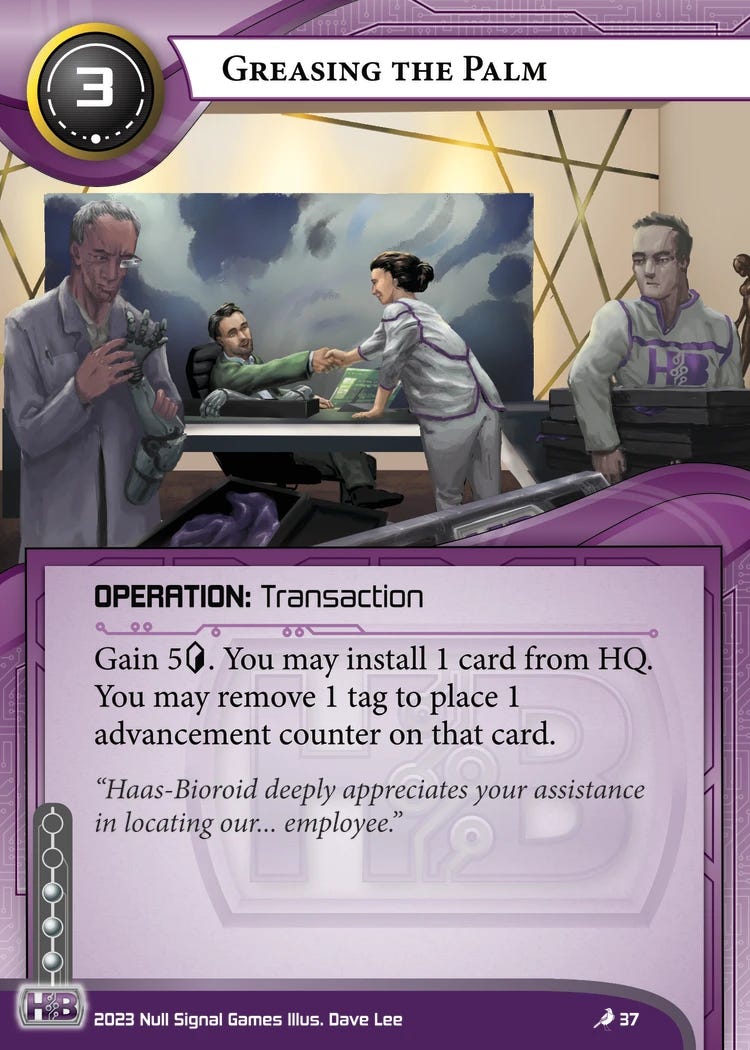
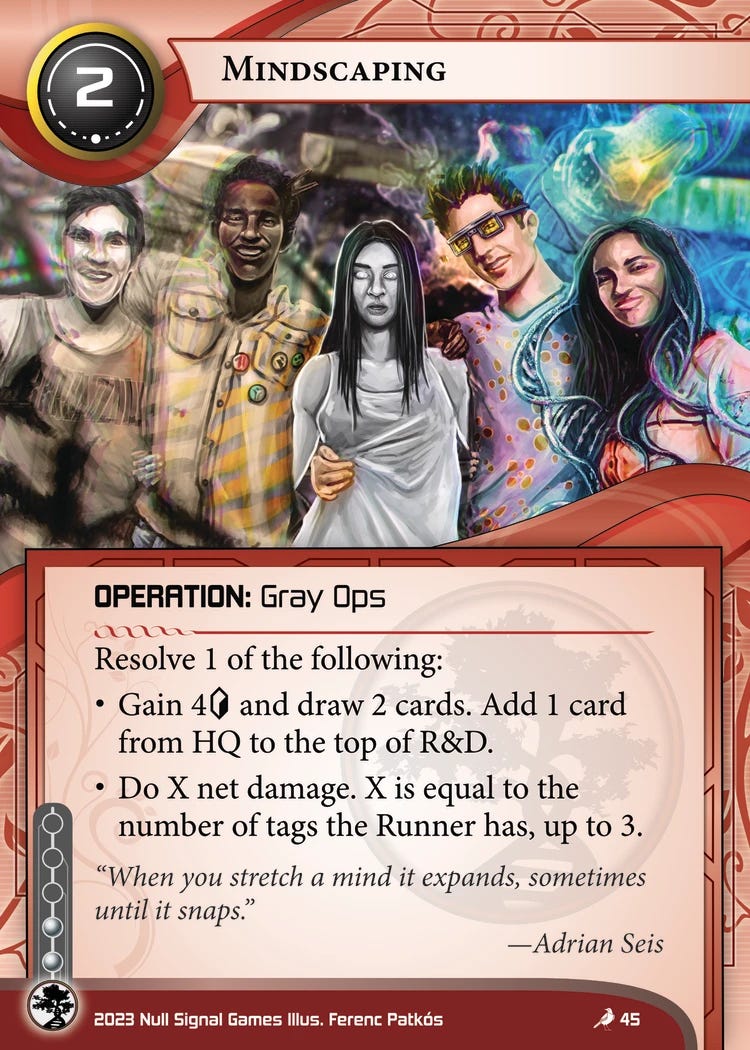
Both Greasing the Palm and Mindscaping are otherwise ordinary economy cards that have some additional utility. Greasing the Palm sees common use alongside Wage Workers or MirrorMorph to get an additional click, and Mindscaping allows you to control your R&D slightly.
If your deck does nothing with tags, it is still worth playing these cards.
However, if your runner opponent does have tags, both of these cards gain powerful effects for their respective factions. Suddenly, your Greasing the Palm becomes a credit-positive fast advance tool. And while a single Mindscaping with one tag isn’t much of a threat, woe the runner who thinks they can float three tags against Jinteki with no consequences.
Even in decks that otherwise did not care about giving the runner a tag, tags still matter. There’s a risk associated with being tagged in every matchup, even those that were previously “safe”.
But that’s not the biggest change. For that, we have to move to the next set, and the flagbearer of the new tag design.

Five words are what set apart this new era of tag-based strategies:
if you had no tags
It is the simplest, most effective answer to the question previous tag-based strategies didn’t have to content with: why would you clear tags?
Well, because otherwise your cards don’t work. Each of the cards printed alongside Sebastião either requires the runner to have no tags to play it (Eye for an Eye, Privileged Access) or are resources and therefor vulnerable to the corp trashing them if the tags stay around.
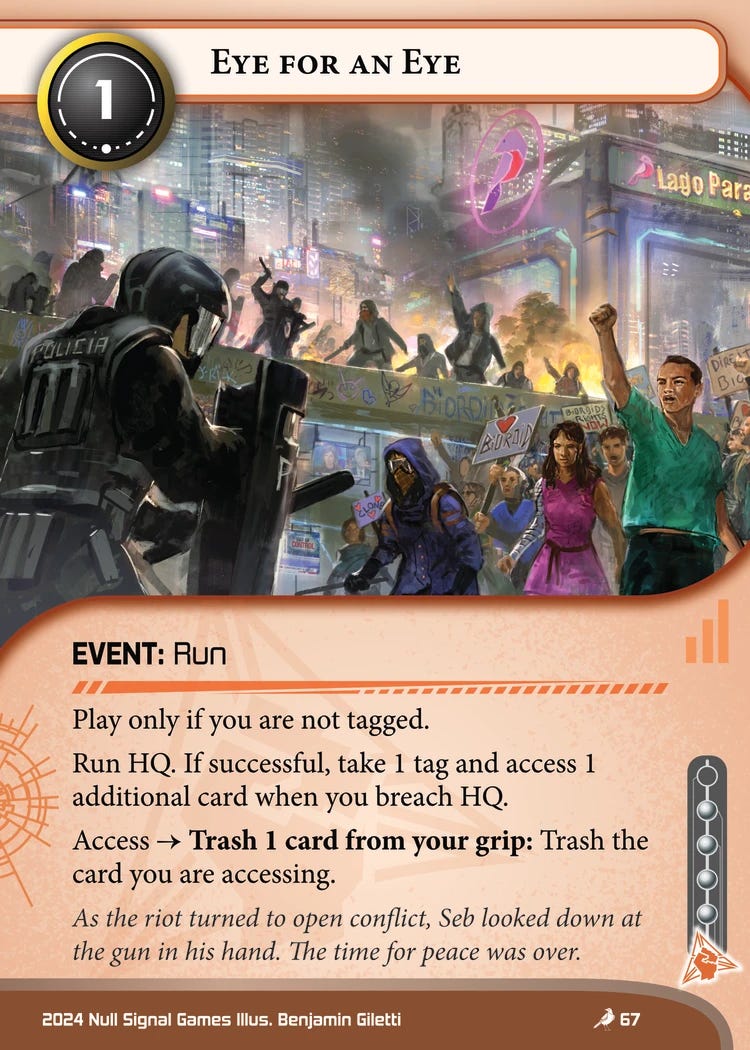
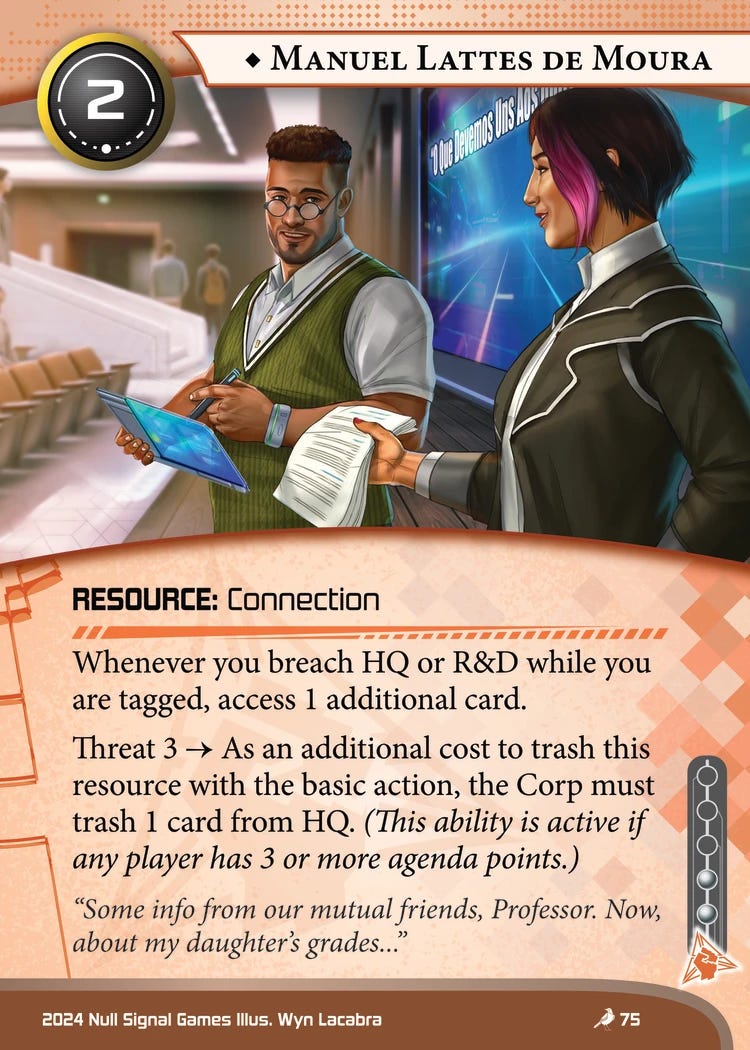
This fundamentally alters how these tag-based strategies function. You cannot float as many tags as you want, and in fact are punished for doing so, as your strongest cards are unplayable, or vulnerable to be trashed by the corp. And so, a balance: taking these tags must also mean that you have to clear them.
One of the members of the Green Level Clearance Discord server, in trying to distinguish between strategies that just want to take as many tags as possible (historically called tagme or tag stacking) and decks like this that want to clear their tags referred to it as “tag dancing”. I love that term, so I’m using it.
So, welcome to the new era of tag strategies, and get your dancing shoes on for a new runner ID.
… and Future.
Previewed here: https://nullsignal.games/blog/vantage-point-and-cybernoir/
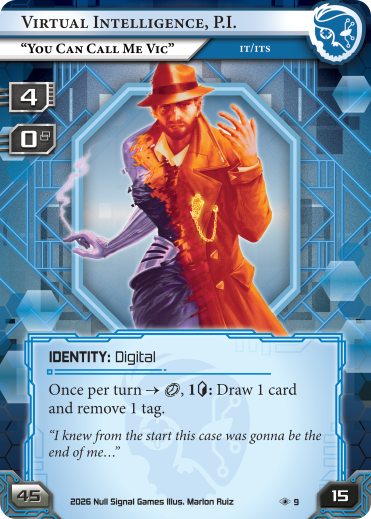
Introducing the Virtual Intelligence, P.I. I’m just going to call it Vic.
Virtual Intelligence, P.I. – “You Can Call Me Vic”
Criminal Identity: Digital
Pronouns: It/Its
Minimum Deck Size: 45 – Influence: 15 –
mu limit: 4 – Base link: 0
Once per turn → click, 1credit: Draw 1 card and remove 1 tag.
“I knew from the start this case was gonna be the end of me…”
Illustrated by Marlon Ruiz
Vic provides a less complicated, if not less effective answer to a tag-based strategy that still cares about clearing tags. Why? Because that’s the only thing it helps you with.
Looking at the ability, it could be rewritten as “the first time each turn you use the basic action to clear a tag, gain one credit and draw one card.” I’m glad they didn’t word it that way, but looking at it through that lens, it is clear what benefit this ID brings to the table.
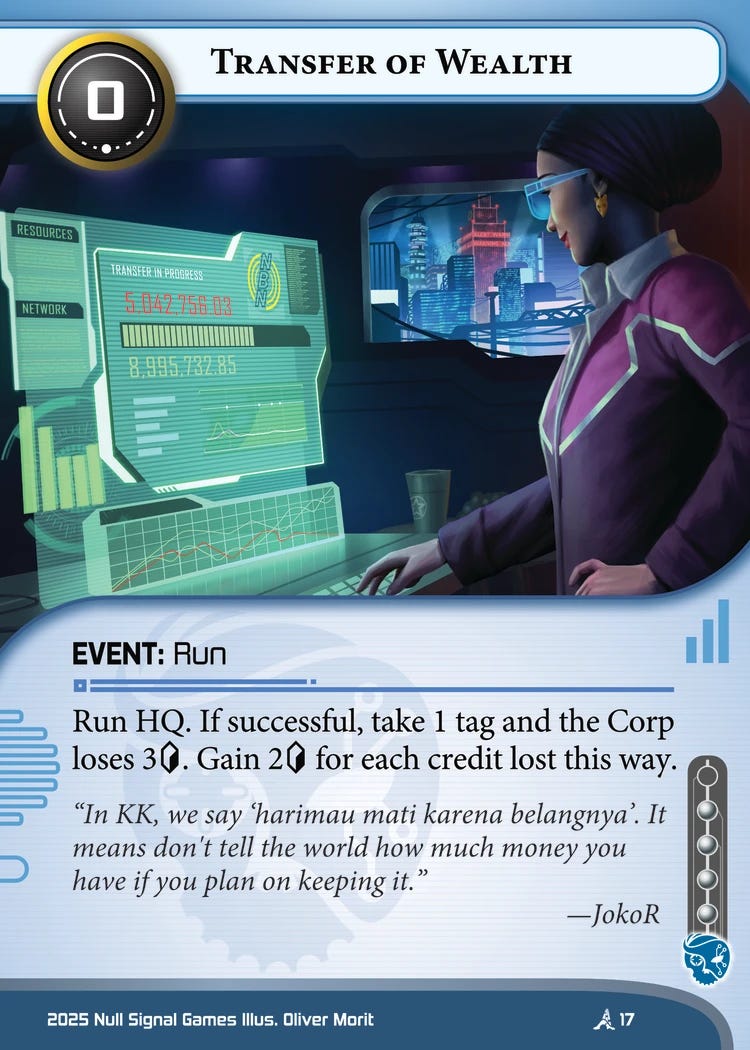
If you never clear any tags, this ID does nothing. Fortunately, there is a faction-defining card in Transfer of Wealth that just so happens to give the runner a tag. For as long as this card will be legal, criminals will be playing it, and so Vic has at least one use for its ability.
And undoubtedly there will be more cards that give criminals tags in Vantage Point. However, without seeing these cards, it is incredibly difficult to picture what Vic does. A lot of the most obvious cards are those printed alongside Sebastião, which raises the question: why aren’t you just playing Sebastião?
The answer, I suspect, we will discover in the coming weeks. But for now, let’s look at a few cards through the lens of Vic.
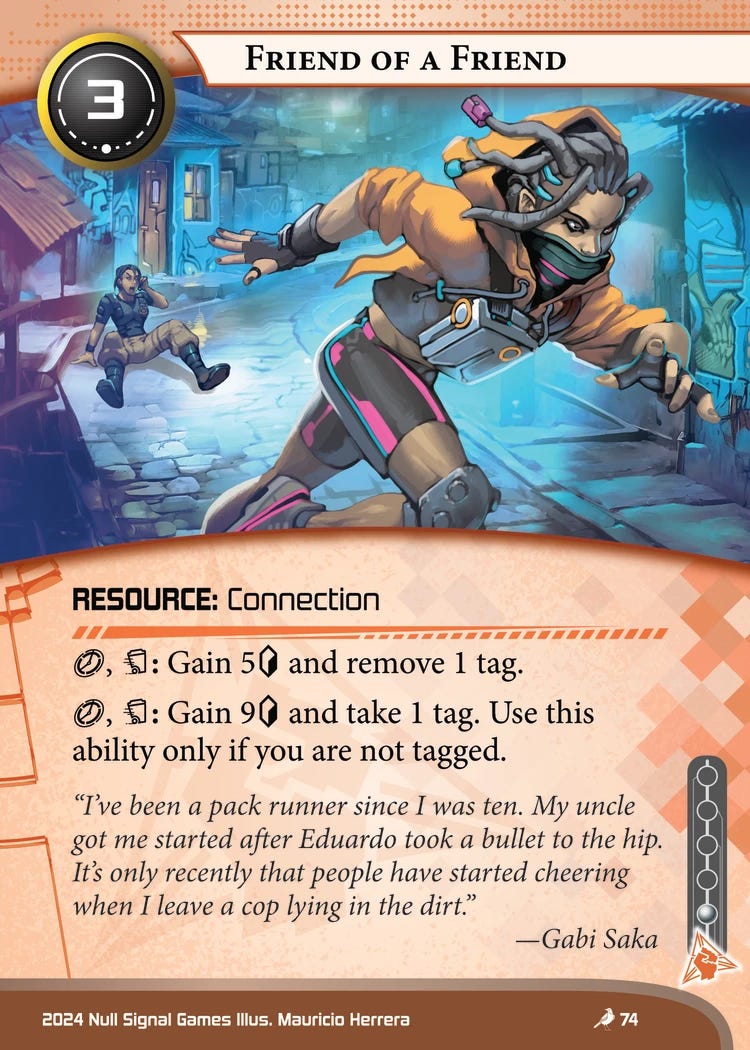
First up is Friend of a Friend, and it isn’t great. Without Sebastião’s ability to discount and clicklessly install, this card costs three credits and a click to install. Then a click and a tag to gain nine credits, a net of six. Finally, we use Vic to clear the tag and draw a card, at the cost of another click and a credit.
Three clicks and a card to net ourselves five credits and a card. Not unplayable, but as far as economy goes, I’m not impressed. Still, I suspect these may show up in Vic decks occasionally, because…

Privileged Access is a powerful recursion effect, especially once you hit threat 3. At only 2 influence, this is fine to splash into a deck. Being able to recur a connection could be a good way to turn Friend of a Friend into more economy, but that’s only the start. With this in your deck, limited-use breakers like Revolver or Propeller become much more appealing, getting an extra use at a bargain rate.
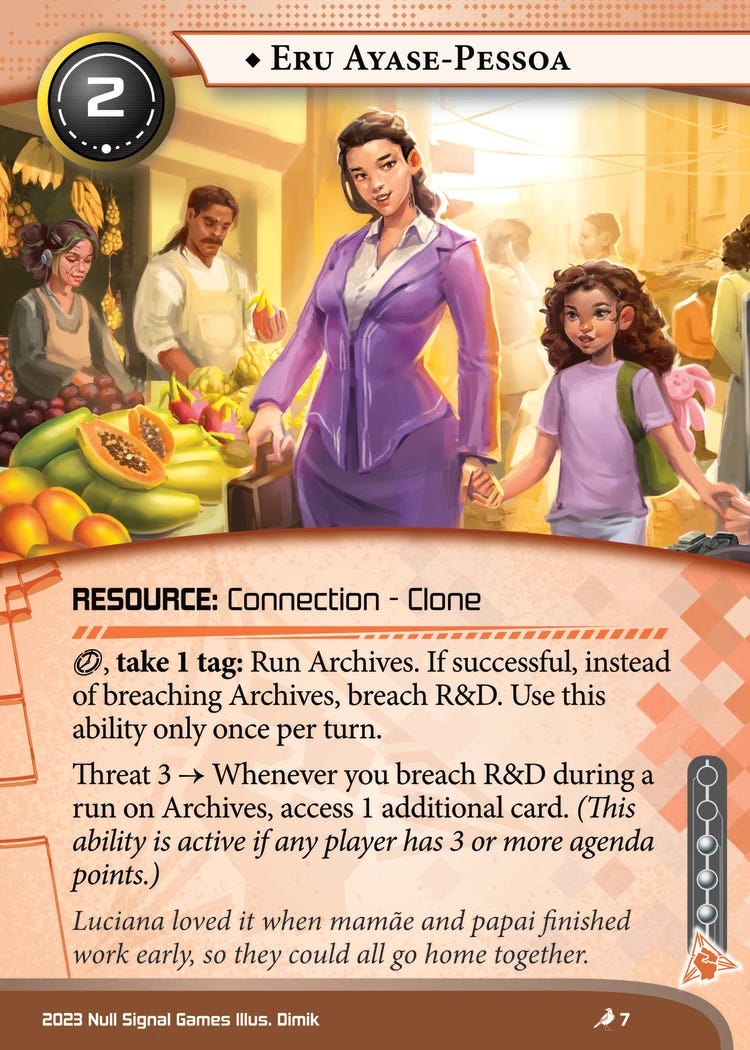
Eru Ayase-Pessoa might be the best card we have for Vic so far. Both their abilities are limited to once per turn, and it provides a strong degree of pressure on the corp while allowing you to keep drawing through your deck at a reasonable pace. While the three influence is a bit of a sting, I imagine a lot of Vic decks will want to play Eru.
How much could a tag cost, anyway? Like 2 credits?
Because there isn’t a lot to talk about Vic itself yet, I opted to talk about tag-based strategies in general in this article. And there is one last thing I want to cover before I go, which is the parasitic nature of this kind of design.
What I mean by that is that when using a tag as a cost, as on many of these cards, there’s a default cost associated with clearing it. That being two credits and a click. However, both Sebastião and Vic change this value proposition, in Seb’s case by giving you a freebie, and in Vic’s case by offering a discount and a card.
If cards are designed such that clearing a tag comes with a discount, they can be underwhelming and underpowered if they’re played in anyone else, who has to pay full price for the tag removal service. Fortunately, there is another preview card that happens to provide an answer.
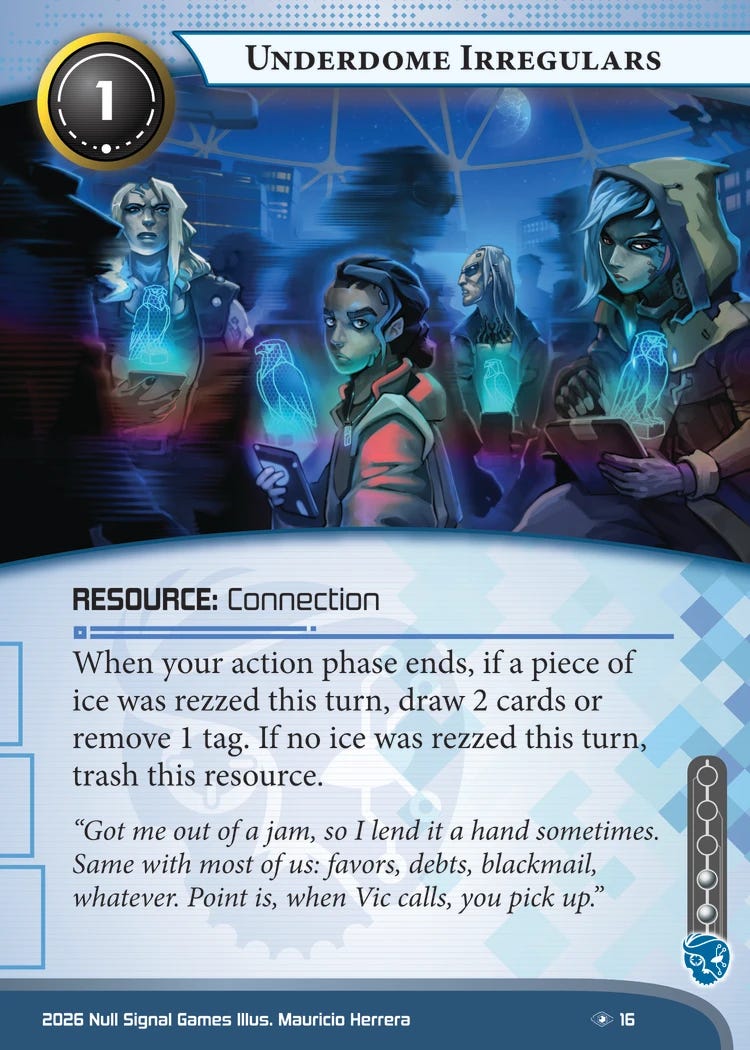
When first previewed, I assumed the Underdome Irregulars were meant as a source of card advantage in Baz decks. I still think that, but I also think that the “remove 1 tag” clause makes a lot more sense if this set will include a bunch of ways for criminals to tag themselves.
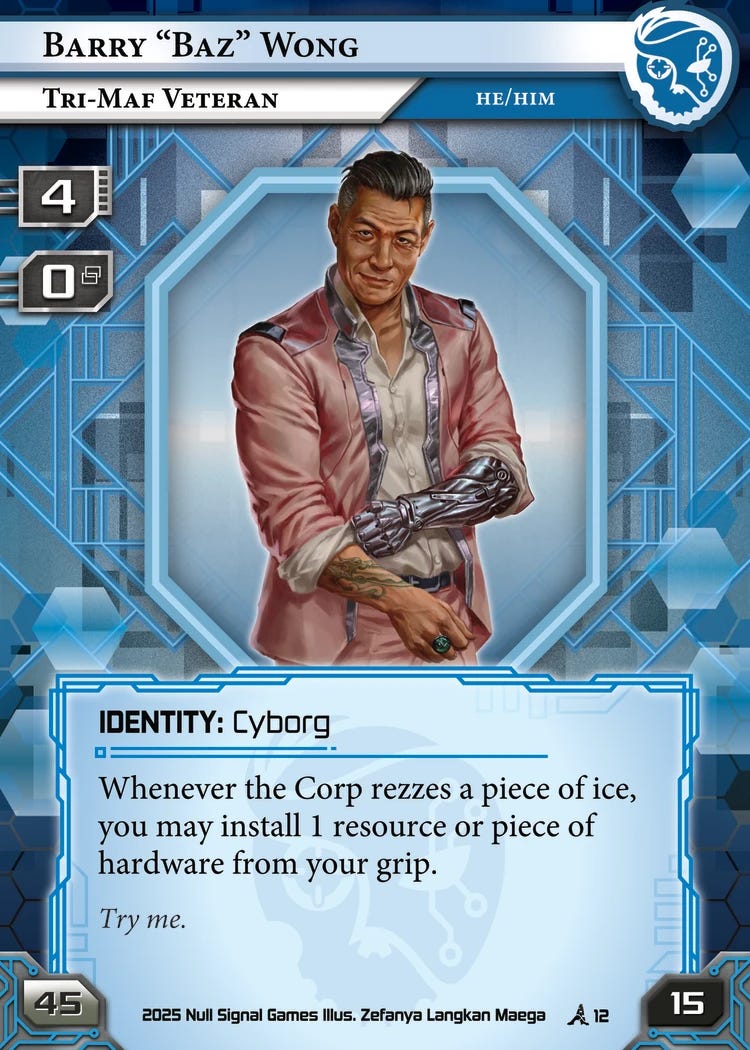
While thematically linked to Vic, I don’t believe we will see this card in a lot of Vic decks. This is instead useful for other decks (again, most likely Baz) to use these cards without paying the full cost of clearing a tag. When looking at it through this lens, these self-tagging cards become a two-part synergy.
This results in a deckbuilding cost: slots dedicated to clearing tags instead of something else. This is a price that Vic doesn’t have to pay, as it has access to a better tag removal from the start of the game. But even then, Vic might want to upgrade.
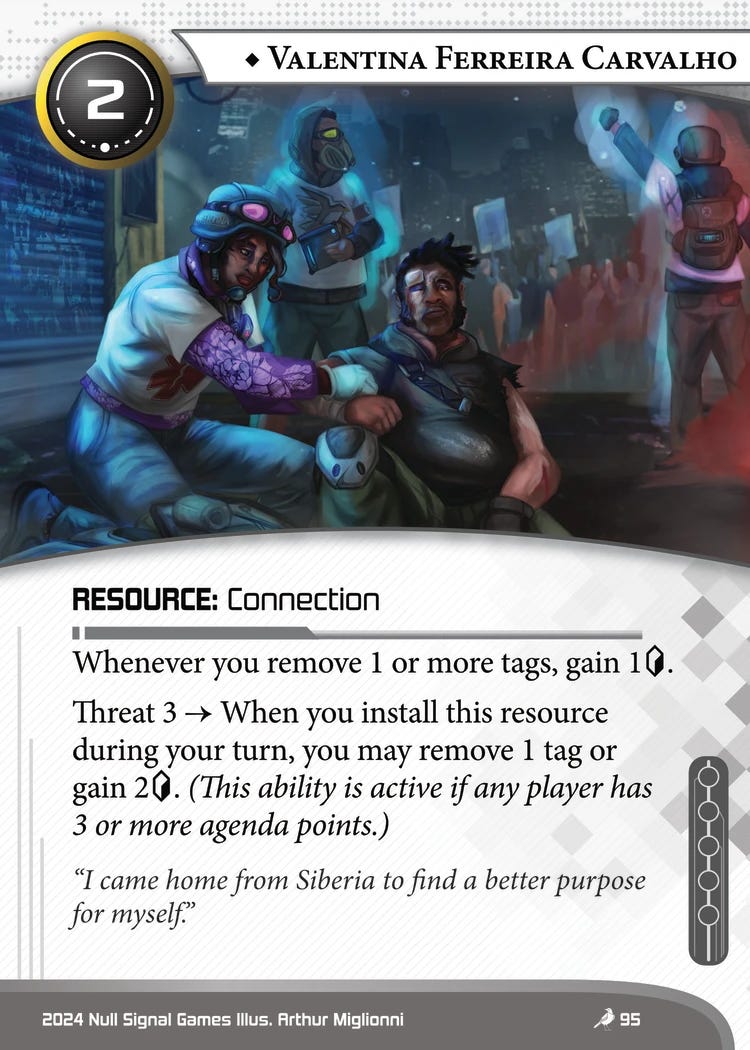
Valentina fits perfectly in Seb, but should work just as well with Vic. We will have to see exactly how many tags you end up clearing over the course of a game, but I expect to see her played.
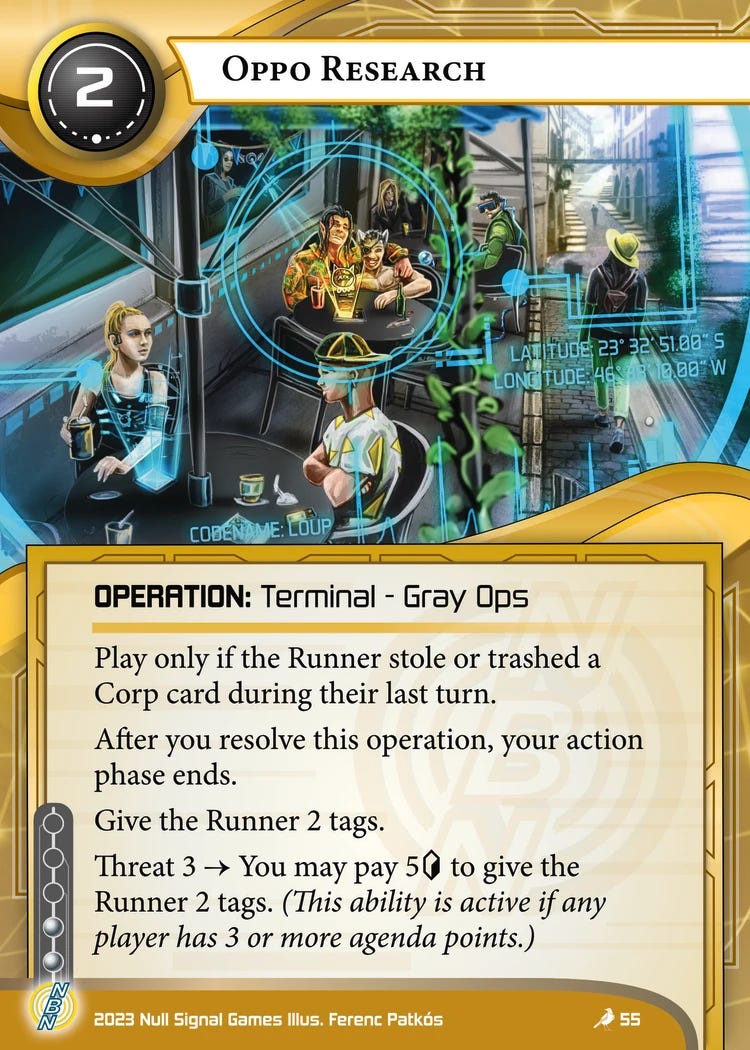

One final observation is that Vic’s ability can only be used once per turn, which creates opportunities both in designing corp cards that pressures through multiple tags, or in other tag removal cards that deal with multiple tags at once.
I feel there is a lot more about Vic I could write, from it being a Digital ID to the awesome noir themes mentioned in the preview article. Or what about that telephone that might be Vic’s console? But any good investigator knows that baseless speculation won’t get them anywhere, and that it is better to stick to the facts.
Vantage Point preview season has only just started. There are still a lot of cards left to be shown, and I’m sure many of the questions posed today will be answered in the weeks to come.
I find Vic a little unconvincing even in the decks that want to play it. Mostly because the value Vic provides has a very hard flat cap. It will never be more than the once per turn that's roughly 2c of value. And frankly, even if you hit Vic EVERY turn, it's hard to believe that beats Zahya, let alone meta dominant Sable.